
Location: SE Saskatchewan, Canada, Northern Portion of the Williston Basin, Onshore
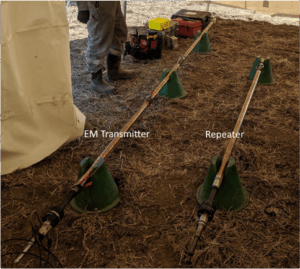
Summary: An energy company used MWDPlanet’s EM (Electro-Magnetic) transmitter-based telemetry system to successfully perform nitrogen fluid drilling operations in an anhydrite rich area without the help of an EM signal repeater. This was the first time for the area that an EM system effectively transmitted through the casing and the anhydrite rich formations, providing reliable signals in the lateral sections at the challenging site. Subsequently, MWDPlanet’s EM system was successfully repeatedly deployed for drilling operations in the area.
Case Study 1 — Deep HPHT Sidetrack with Geosteering Complexity
Objective
Local to the drilling area energy company presented MWDPlanet with a challenge of supplying an EM system that could work in an anhydrite rich area. Anhydrite formations have high resistivity when they are dry, making it difficult to pass any electrical current. But as soon as anhydrites are saturated with drilling fluid, they become conductive either due to the natural presence of salts or the drilling fluid chemical properties. This creates an environment with an extreme range of loads, from 0.1 Ohm to kilo Ohms, which was outside of the range EM tools were designed for.
|
Condition |
Typical Range (Ω·m) |
Notes |
|
Dry (unsaturated) |
>10⁶ Ω·m |
Extremely resistive |
|
Freshwater saturated |
10³ – 10⁴ Ω·m |
Still very resistive |
|
Brine saturated (10,000 ppm+) |
10² – 10³ Ω·m |
Most typical in sedimentary basins |
|
Clay-contaminated zones |
Can drop below 100 Ω·m |
If porous zones or clays are present |
Table 1. Electrical Properties of Water-Saturated Anhydrite
Because of these formation challenges, local operators typically use mud pulse transmitter-based systems. However, to minimize significant fracking costs, the energy company was in the process of switching to nitrogen drilling, which made the use of a mud pulser impossible, therefore an EM transmitter was the only feasible solution. Several attempts were made with an EM system with a repeater of a well-established competitor, but understandable problems with the signal reception persisted, which is when MWDPlanet received the call to see if we wanted to test our EM tool in these extreme conditions.
The design challenge for MWDPlanet was to develop an EM transmitter that can constantly self-regulate and stabilize its maximum power output for a consistent signal.
Results
MWDPlanet had previously developed and tested an EM transmitter that could work in the casing, which is typically difficult for EM systems, but would prove useful in situations when the downhole BHA (Bottom Hole Assembly) needs to be oriented for specific drilling applications. The conditions in a casing match those of the presented drilling conditions when the output load is close to 0.1 Ohm.
The wells typical to the area are approximately 1850 meters TVD, with one to two kms of horizontal length.
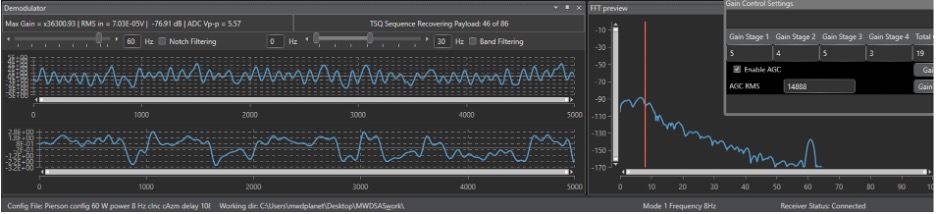
The patented digital output of MWDPlanet’s EM transmitter performed great both with and without a repeater in the first test well. The transmitter worked throughout the entire well and decoded through the casing and out of the shoe. The EM received signals were stable at around -60 to -85 dBm throughout the entire well, with the noise level at the drilling site of -75 to -95 dBm.
We can correlate increase in the power output with the strength of the receiving signal at the surface. For example, the 15W downhole output produced signal strengths at the surface level averaging -90dBm to -100dBm. While the 60W downhole output produced signal strengths of -57 dBm and -86dBm.
The current design of the EM transmitter is limited to 200W output. The firmware safety measure limits the configurable output up to 60W.
To maximize our understanding of the characteristics of the received signal and noise at the drilling locations, MWDPlanet tested three different antenna positions at each well:
- With a BOP connection,
- Without a BOP connection,
- With a connection to the producing well.
The data received from these tests is currently used for further development of noise filtering in future iterations of our EM systems.
Of note is MWDPlanet’s EM receiver’s ability to decode even the weakest signal. The EM receiver can decode signals even at negative signal-to-noise ratios, down to -132 dBm. In comparison, analogue systems need a positive 2:1 signal-to-noise ratio to work.
The patented power efficiency of MWDPlanet’s digital sinus wave output is up to 97% efficient compared to the 50% and less power efficiency of competing EM systems with analogue square wave signals. The ability to run MWDPlanet’s EM transmitter from the battery instead of the downhole turbine provides increased flexibility to the BHA design.
With the max configurable power output of 60W and 21A peak-to-peak signal, the tool used only ~6% of the battery capacity in the 8hrs that it was downhole, drastically reducing the frequency of battery changes.
Figure 1. Signal Strength at TVD 1136m, Sandstone Formation.
Results
The transmitter worked throughout the entire well and decoded through the casing and out of the shoe
Even without the repeater
The EM receiver can decode signals even at negative signal-to-noise ratios, down to -132 dBm
In comparison, analogue systems need a positive 2:1 signal-to-noise ratio to work
The patented power efficiency of MWDPlanet’s digital sinus wave output is up to 97% efficient
Compared to the 50% and less power efficiency of competing EM systems with analogue square wave signals
MWDPlanet Pegasus EM Transmitter Specifications
|
Carrier Frequency |
1-32 Hz |
|
Baud rate |
Up to 16b/s for BPSK (up to ½ of the carrier frequency) |
|
Power |
0.1-60W with galvanically isolated output |
|
Voltage |
1-110V (peak-peak) |
|
Current |
0-21A (peak-peak) |
|
Power Efficiency |
97% |
|
Output Impedance-based Modes |
· Constant power · Constant voltage · Constant current |
|
Operating Temperature (Max) |
175°C (347°F) |

Conclusion
Based on the successful trial run of MWDPlanet’s EM system in the first well, our EM tool has been repeatedly successfully deployed by the energy company in the area during 2021-2024.
New versions of the EM system as an active part of the EM/MP intelligent multi-channel telemetry system are being integrated with RSS.
Contact Us
Reach out to find out how our tools can improve your drilling operations